

The Role of Neurological and Psychological Factors in the Development of Musician’s Focal Dystonia
Musician’s focal dystonia (MFD) is a task-specific neurological disorder that affects approximately 1% of professional musicians. This article examines MFD from both neurological and psychological perspectives and how these factors interact. Neurologically, research emphasizes the role of the basal ganglia, dopaminergic dysfunction, and the possible involvement of the cerebellum in disrupting fine motor control. Psychologically, MFD is more prevalent in musicians with anxiety, obsessive–compulsive traits, perfectionism, and adverse childhood experiences. Reviewed literature suggests that these neurological and psychological factors interact, with stress and emotional instability influencing motor pathways and learning processes. By integrating these perspectives, the article aims to provide musicians, educators, and health professionals with a clearer understanding of MFD.
Introduction
Musician’s focal dystonia (MFD) is a neurological disorder that affects professional and highly skilled musicians. For professional musicians, developing the disorder could mean the end of their careers; therefore, there is still stigma and fear associated with the diagnosis. The disorder is not widely known, and it is challenging to diagnose. Lack of knowledge can lead to misdiagnosis, or cases of MFD may remain undiagnosed (Detari et al., 2022). The aim of this article is to provide musicians, educators, and health professionals with information about MFD, including its neurological mechanisms, the psychological factors that may contribute to its development, and the ways in which these factors interact. Gaining a deeper understanding of the disorder within the musical community may not only support prevention but also encourage the development of new treatment approaches (Altenmüller & Jabusch, 2010).
Medically, dystonia is defined as: “a movement disorder characterized by sustained and recurring involuntary muscle contractions causing abnormal, often repetitive, movements, postures, or both” (Albanese et al., 2013). In pathology, the term focal (“localized”) refers to something that is limited to a specific area or point, rather than being widespread or affecting a larger area of tissue (RxList, 2021). Although this disorder is associated with basal ganglia dysfunction and the dopaminergic system, new research also implicates the cerebellum (Brüggemann, 2021). Psychologically, musician’s focal dystonia is often associated with anxiety, obsessive-compulsive disorder, and adverse childhood experiences such as emotional neglect (Alpheis et al., 2022; Mula et al., 2012).
Musician’s focal dystonia-short overview
Musician’s focal dystonia is a task-specific neurological disorder. It normally appears as painless involuntary muscular contractions and loss of voluntary motor control of trained movements. It appears only when performing a particular task — playing an instrument — while it is absent when the same body part is engaged in other activities (Détári, 2023). In a hypothetical case, during a practice session, a pianist’s second finger involuntary contracts, but when the pianist is typing on the computer, they have full control over their fingers. Symptoms most often appear in the hands and involve slowness of the fingers, uncontrollable movements, tension or stiffness in the hand or forearm and weakness of the hand. In embouchure dystonia (focal dystonia of wind instruments), where muscles around the face and tongue are affected, this manifests as trembling and difficulty in producing a clear sound (Comoletti and Mercogliano, 2024).
Standard treatments
Treatment has typically included botulinum toxin injections, oral medication or neurosurgery (Pandey, 2015). Botulinum toxin (a neurotoxin that blocks the neuromuscular signal transmission) is injected into the muscles that move involuntarily, thereby weakening them and reducing the symptoms of dystonia (Zoons et al., 2012). Standard dosing does not exist, dosage varies highly depending on the patient’s response and the muscles affected. Identifying the injection site is often difficult because the unwanted movement usually involves more than one muscle. To improve injection accuracy, ultrasound guidance and electromyography (EMG) are used. The effects of this treatment are temporary and usually last three to four months (Kaplan et al., 2025).
Oral medication and neurosurgery are more often used for generalised dystonia, whereas in focal dystonia they are aimed at symptomatic relief. In general, anticholinergics are the most effective oral treatment. Other medications that are used are Baclofen (it affects GABA receptors), benzodiazepines and dopamine-blocking agents – antipsychotics. The most common neurosurgical treatment is deep brain stimulation (DBS), which involves implantation of electrodes connected to a pacemaker-like device that delivers electrical impulses to targeted brain regions. For patients with focal dystonia, the target is the globus pallidus internus (GPi), which is part of the basal ganglia (Cloud & Jinnah, 2009; Thenganatt & Jankovic, 2013).
Pedagogical treatment strategies include immobilization of an affected limb and sensory re-education (Altenmüller & Jabusch, 2010). Sensory re-education uses the role of somatosensory input to influence the human brain, for example, practising the instrument with gloves (Butler & Rosenkranz, 2006). An example of a pedagogical treatment strategy used by Jabusch et al. (2005) involved limiting the movement of affected body parts to the level of tempo and force at which the involuntary movements did not occur. Splints were used to limit movements of adjacent fingers, and mirrors were employed to help patients recognise dystonic movements.
Basal ganglia, dopamine and function of direct and indirect pathways
To understand the neurological basis of dystonia, it is important to focus on the basal ganglia, which play a central role in motor control and emotional activity. Although the content of this part is not directly focused on musicians, understanding the types of dystonia and the underlying brain mechanisms is essential for comprehending the broader concept of MFD (Altenmüller & Jabusch, 2010; Brüggemann, 2021). Studies of cervical and generalized dystonia show high levels of stigma, especially when observers know little about the condition (Gharzai et al., 2020; Rinnerthaler et al., 2006).
Dystonia is caused by lesions in the brain mostly in the basal ganglia, thalamus, brainstem, and putamen (Hallett, 1998). It was thought that the basal ganglia were the main region in the brain responsible for dystonia but newer research has shown that the cerebellum may also be involved (Brüggemann, 2021). MRI findings showed that patients with cervical dystonia have increased size of the cerebellar flocculus (smooth pursuit), hemispheres (motor planning, coordination and timing), and vermis (postural control), compared to controls. Individuals with cervical dystonia and focal limb dystonia were also found to have an abnormal eyeblink conditioning, a pathway that relies on cerebellar circuits (Wang et al., 2025).
Basal ganglia are a part of the brain that consists of a group of subcortical nuclei and is mainly responsible for motor control, learning, executive functions and emotions. Anomalies in this part of the brain can result in movement disorders such as Parkinson’s disease, dyskinesias, obsessive compulsive disorder, and abnormal mood changes such as euphoria or apathy (Lanciego et al., 2012).
In the basal ganglia, there are two types of pathways: direct and indirect. GABA is an inhibitory neurotransmitter, while glutamate is an excitatory neurotransmitter. The direct pathways facilitate voluntary movements in the target muscles, while the indirect pathways inhibit movements in other muscles not involved in the desired action. The goal of the direct pathways is to activate the motor cortex, while the goal of the indirect pathways is to deactivate the motor cortex. When both pathways function properly, movements are well-coordinated, smooth, and steady. In dystonia, the balance between excitation and inhibition within the basal ganglia pathways is believed to be altered, leading to an abnormal increase in the excitation of the motor cortex (Rocha et al., 2023).
Figure 1
Function of direct and indirect pathways in basal ganglia
A study by Symonian et al. (2017) provides evidence of dopaminergic dysfunction in the basal ganglia, affecting not only the indirect but also the direct pathways. 35 people participated in the study: 11 with writer’s cramp, 12 with laryngeal dystonia, and 12 healthy volunteers (with no history of neurological or psychiatric disorders). Writer’s cramp is a type of focal dystonia that causes involuntary muscle overactivation during handwriting. Common symptoms include applying excessive pressure on the pen and desk, along with an abnormal writing posture. Writing becomes tiring and is often accompanied by pain (Dommerholt et al., 2016).
Laryngeal dystonia is task-specific and selectively affects speech but does not interfere with whispering or natural vocal behaviors like laughing, crying, or yawning (Simonyan et al., 2021). The use of high-resolution research tomography showed that among patients with focal dystonia, the normal pattern of dopaminergic activity in the brain’s striatum was disrupted. The striatum is a deep brain nucleus and a part of the basal ganglia that links motivation with motor movements in simple motor tasks and more complex cognitive tasks, such as reward processing, decision-making, and social interactions. Furthermore, the availability of dopamine D1 receptors was increased by 19.6% to 22.5% in patients with writer’s cramp which indicates hyperactivity of the basal ganglia. The authors explain that the mechanism of abnormal basal ganglia function in focal dystonia involves an increased number of dopamine receptors that abnormally enhance excitation in the direct pathway, and a decreased number of dopamine receptors that abnormally reduce inhibition in the indirect pathway. In patients with isolated focal dystonia affecting the hand and larynx, researchers found increased levels of dopamine D1 receptors and decreased levels of D2 receptors. This suggests that the direct pathway in the brain’s basal ganglia is overactive, while the indirect pathway is underactive (Simonyan et al., 2017).
MFD provides an example of how imbalance between direct and indirect pathways manifests itself. Involuntary contractions affect specific muscle groups, particularly those controlling the arms, fingers, and facial muscles. As a result, musicians experience loss of fine motor skills when playing the instrument (Kita et al., 2018; Simonyan et al., 2017).
Psychological factors
Research done by Ioannou et al. (2016) suggests that psychological factors contribute to the development of focal dystonia. Among the psychological factors that may increase the risk for MFD are state of anxiety, depression, obsessive-compulsive disorder and specific phobias (Alpheis et al., 2022; Comoletti and Mercogliano, 2024; Jabusch & Altenmüller, 2004; Mula et al., 2012). The research also found that patients who had perfectionistic and stressful personalities developed MFD ten years before the group that did not have these tendencies (Comoletti and Mercogliano, 2024). Zosso and Schoeb (2012) describe that musicians who don’t know about the disorder, usually mix focal dystonia with playing abilities. In the same study, a participant also reported that his university told him he was not practicing enough, and highlighted how musicians often fear that health providers may be unable to properly diagnose or treat their condition.
Muscular activity and muscular contractions on both sides of joints are increased in people experiencing higher levels of anxiety or emotional instability. Anxiety, emotional instability, and other psychological factors have been linked to altered stress responses. This suggests that stress may influence the motor system through hormonal or stress-related emotional changes. Focusing on stress response and anxiety may be important in the treatment of musician’s focal dystonia (Comoletti & Mercogliano, 2024). The triggering factors for musician’s dystonia are not fully understood. Discussions and research are still ongoing about whether the causes are more related to overuse and psychological factors or are genetic and neurophysical (Alpheis et al., 2022). A study (Jabusch & Altenmüller, 2004) compared 20 musicians with focal dystonia (3 brass players with embouchure dystonia and 17 with hand dystonia) with 30 musicians without the disorder. Musicians filled out different questionnaires focusing on anxiety disorders, and the results showed that unlike MFD-free musicians, those with MFD reported social anxiety and other phobias that had been there before the onset of dystonia.
Figure 2
Anxiety disorders
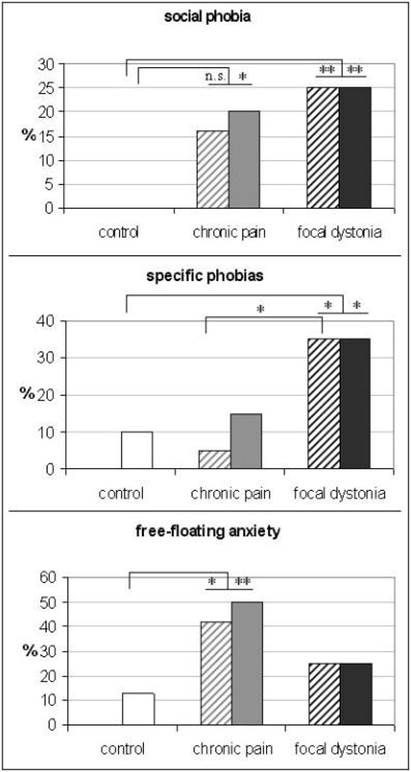
Note: This graph shows the anxiety disorders comparing the control group and musicians with dystonia and chronic pain. Striped bars represent the amount of anxiety before the onset of playing-related problems. Filled bars represent the amount of anxiety after the onset of the playing-related problem (Jabusch & Altenmüller, 2004). Specifically, agoraphobia, social phobia and perfectionism had been more present in musicians with focal dystonia. More importantly, it seems that the anxiety was already present before the manifestation of the disorder (Jabusch & Altenmüller, 2004). Grunewald (2007) discusses chronic overwork and playing in a fatigued state as an important factor in the development of dystonia as well.
Obsessive-compulsive disorder and focal dystonia
The main theory of obsessive-compulsive disorder (OCD) focuses on abnormalities in brain circuitry. This theory is supported by evidence from brain imaging studies. Early PET imaging studies found increased brain activity in specific areas in patients with OCD. More recent MRI scans also confirm abnormalities in these brain regions. Interestingly, similar brain networks are involved in motor disorders, suggesting a potential link between OCD symptoms and motor disturbances (Mula et al., 2012).
New research suggests that some motor symptoms might be linked to non-motor characteristics, such as the neuropsychological profile, which is associated with anxiety. However, it is not yet entirely clear whether these characteristics originate from the disease itself or are related to motor abilities (Mula et al., 2012). The dysfunctional physiology may be related to a similar genetic predisposition, or the neurobiology of focal hand dystonia may affect similar regions as that of OCD (Voon et al., 2010). Corea et al. (2012) found that MFD patients have higher obsessive-compulsive symptom scores than individuals with similar functional disabilities resulting from other neurological disorders. Mula et al. (2012) examined the relationship between obsessive-compulsive disorder and three groups of people: individuals with focal dystonia, those with hemifacial spasm, and a healthy control group. The study included patients who were already receiving doses of botulinum toxin. Various questionnaires were used to assess psychiatric symptoms and obsessive-compulsive tendencies. A total of 60 individuals were included, with an average age of 60. The presence of OCD was 26% higher in patients with focal dystonia compared to the control group. Particularly in patients with hemifacial spasm, there were higher scores for contamination (obsessive fears of germs, dirt, or illness, linked with compulsive cleaning or hand-washing) and aggression (intrusive, unwanted thoughts of harming oneself or others, or fears of accidentally causing harm) compared to those with focal dystonia. Overall, there were no significant differences in psychological profiles among individuals with focal dystonia, hemifacial spasm, and healthy controls, except in areas related to the physical distress caused by the movement disorder itself.
Interestingly, in the focal dystonia group, anxiety and depression scores were correlated with some of the psychological dimensions (such as somatization, obsessive-compulsive traits, hostility, paranoia, and sleep problems) measured by the Symptom checklist-90 (SCL-90) questionnaire. SCL-90 is a widely recognized self-report questionnaire designed to assess a broad range of psychological and psychiatric symptoms. Participants rate the extent to which they have experienced various symptoms such as crying easily, spells of terror or panic, and trouble falling asleep during the past week (Derogatis, 1994). These findings suggest that mood and anxiety symptoms may play a more significant role in focal dystonia and that dysfunction of the central nervous system may contribute to both motor and non-motor symptoms.
The study thus indicates that patients with focal dystonia and hemifacial spasm often exhibit mild obsessive-compulsive symptoms, which may be influenced by brain disorders and past psychiatric history (Mula et al., 2012).
Adverse childhood experience and focal dystonia
The psychological factors associated with the development of focal dystonia may be partly rooted in early life experiences. Adverse childhood experiences (ACEs) are traumatic events that happen before the age of 18. They cover a broad range of adverse experiences, including physical and emotional neglect, sexual and emotional abuse, exposure to domestic violence, parental mental health problems, family incarceration, separation, and substance misuse (Tzouvara et al., 2023). These events have been associated with the onset of anxiety, perfectionism and abnormal stress responses which are psychological factors linked to the development of MFD. On a neurobiological level, ACEs are known to influence the hypothalamic-pituitary-adrenal (HPA) axis, the stressful situations are therefore assessed more quickly as “threatening”. This promotes quicker activation of the amygdala, which leads to reinforcement of dysfunctional learning patterns, affecting movement learning and motor memory (Alpheis et al., 2022).
Studies of women with ACEs have shown increased activation in the motor cortex and decreased activation in the hippocampus (Bremner et al., 1999). Studies of people with PTSD have shown increased response in amygdala exposed to stress-related situations. Hyperactivation of amygdala was also shown when participants were presented with pictures of people showing strong emotions. Therefore, the involvement of ACEs in regards to focal dystonia would suggest that focal dystonia is not just a motor circuit disorder, but may also be influenced by dysfunctional stress coping mechanisms (Sherin & Nemeroff, 2011).
Alpheis et al. (2022) recruited 121 patients with musician’s dystonia for a study examining the effect of ACEs on focal dystonia. ACEs were measured with two questionnaires: one covering emotional, physical and sexual abuse and another emotional and physical neglect and perfectionism. The study found that the musicians with focal dystonia reported significantly higher levels of emotional neglect in childhood in comparison to healthy musicians. Other forms of ACE were not associated with musician’s dystonia, nor was perfectionism. In the individually written answers and personal notes to the researcher patients wrote extensively about fear of rejection, performance pressure and emotional neglect. There were some limitations to the study because well-being, anxiety and depression were not measured, and bias in retrospective reports cannot be ruled out. Additionally, the age and gender differences between the two groups may have influenced the results (Alpheis et al., 2022).
Musicians’ dystonia patients reported conflicts among family members that were partially violent, as well as emotional neglect and abuse from family members and pressure to perform well playing the instrument. The control group reported about nonviolent conflicts in the family and bullying at school, but there were no differences in perfectionism between the groups. Male sex, genetic predisposition and late age when first starting to learn the instrument are also among known risk factors (Alpheis et al., 2022). Alpheis et al. found also that ACEs can alter the HPA activity and increase vulnerability to stress. Early childhood stress may be associated with reduced resilience, thereby increasing the risk of developing dysfunctional movements later in life. In this context, practicing and performing under high pressure may contribute to learning dysfunctional motor movements associated with focal dystonia. The study also found that perfectionism is not associated with the severity of focal dystonia.
Conclusion
The interaction between neurological and psychological factors in musician’s focal dystonia is complicated. Focal dystonia may be seen solely as a neurological disorder, but as discussed in the article, psychological factors are also associated with it. There is currently no conclusive evidence that would establish a precise causal relationship between neurological and psychological factors in focal dystonia, suggesting that both should be considered in planning treatment and prevention strategies. This is further supported by the involvement of brain regions involved in both emotional processing and motor control, indicating that psychological and physiological processes are closely connected rather than fully separate systems. Additional evidence includes increased muscle activity in individuals with higher anxiety levels or emotional instability, as well as shared neural networks implicated in both obsessive-compulsive disorder and motor control. Unlike triggers, some risk factors have been researched and described but more evidence is needed. Psychological factors linked to development of focal dystonia are anxiety, perfectionism and abnormal stress response. All of these factors are connected to adverse childhood experiences, suggesting that vulnerability to MFD may be influenced by experiences occurring long before symptoms appear.
Psychological factors are important to consider because musicians live in a highly performance-oriented environment that may amplify stress and anxiety. Musicians who identify risk factors in themselves may start addressing them early enough to prevent the onset of the disorder. Since physiological and psychological factors in MFD are tightly connected, it would be reasonable that musicians as well as professors work on the psychological factors in addition to motor-related difficulties. Professors play a big role in the students’ process and know them well so they can be very helpful in the prevention of MFD if they spot the risk factors early. Focal dystonia is sometimes misinterpreted as poor technique; therefore, it would be beneficial if knowledge about this condition were shared. Further studies should investigate treatment methods focusing especially on psychological aspects combined with movement retraining. With more research and improved understanding of the topic, musicians would be better equipped to recognize, manage, and prevent the disorder.
Literature
Albanese, A., Bhatia, K., Bressman, S. B., DeLong, M. R., Fahn, S., Fung, V. S., Hallett, M., Jankovic, J., Jinnah, H. A., Klein, C., Lang, A. E., Mink, J. W., & Teller, J. K. (2013). Phenomenology and classification of dystonia: A consensus update. Movement Disorders, 28(7), 863–873. https://doi.org/10.1002/mds.25475
Alpheis, S., Altenmüller, E., & Scholz, D. S. (2022). Influence of Adverse Childhood Experiences and Perfectionism on Musician’s Dystonia: a Case Control Study. Tremor and Other Hyperkinetic Movements, 12(1). https://doi.org/10.5334/tohm.687
Altenmüller, E., & Jabusch, H. (2010). Focal Dystonia in Musicians: Phenomenology, pathophysiology, triggering factors, and treatment. Medical Problems of Performing Artists, 25(1), 3–9. https://doi.org/10.21091/mppa.2010.1002
Bremner, J. D., Narayan, M., Staib, L. H., Southwick, S. M., McGlashan, T., & Charney, D. S. (1999). Neural correlates of memories of childhood sexual abuse in women with and without posttraumatic stress disorder. American Journal of Psychiatry, 156(11), 1787–1795. https://doi.org/10.1176/ajp.156.11.1787
Brüggemann, N. (2021). Contemporary functional neuroanatomy and pathophysiology of dystonia. Journal of Neural Transmission, 128(4), 499–508. https://doi.org/10.1007/s00702-021-02299-y
Butler, K., & Rosenkranz, K. (2006). Focal Hand Dystonia Affecting Musicians. Part II: An Overview of current Rehabilitative Treatment techniques. The British Journal of Hand Therapy, 11(3), 79–87. https://doi.org/10.1177/175899830601100302
Cloud, L. J., & Jinnah, H. (2009). Treatment strategies for dystonia. Expert Opinion on Pharmacotherapy, 11(1), 5–15. https://doi.org/10.1517/14656560903426171
Comoletti, S., & Mercogliano, C. (2024). Focal dystonia in musicians, a literature review. Journal of Hand Therapy. https://doi.org/10.1016/j.jht.2024.02.011
Derogatis, L. R. (1994). Symptom Checklist-90-R: Administration, scoring & procedure manual for the revised version of the SCL-90. National Computer Systems
Detari, A., Clark, T., & Egerman, H. (2022). Musician’s Focal Dystonia: a mere neurological disorder? The Role of Non-organic Factors in the Onset of Musician’s Focal Dystonia: An Exploratory Grounded Theory Study. Journal of Health, Music, and Wellbeing.
Détári, A. (2023). Treating the musician rather than the symptom: The holistic tools employed by current practices to attend to the non-motor problems of musicians with task-specific focal dystonia. Frontiers in Psychology, 13. https://doi.org/10.3389/fpsyg.2022.1038775
Dommerholt, J., Hooks, T., Finnegan, M., & Grieve, R. (2016). A critical overview of the current myofascial pain literature – March 2016. Journal of Bodywork and Movement Therapies, 20(2), 397–408. https://doi.org/10.1016/j.jbmt.2016.02.015
Gharzai, L., Harney, J., Higgins, S., High, R., Xu, L., Inciarte, D., Ameer, M. A., & Torres-Russotto, D. (2020). Alarming levels of stigma toward generalized dystonia: A cross-cultural comparison. Clinical Parkinsonism & Related Disorders, 3, 100059. https://doi.org/10.1016/j.prdoa.2020.100059
Grunewald, R. A. (2007). Progression of dystonia: learning from distorted feedback? Journal of Neurology Neurosurgery & Psychiatry, 78(9), 914. https://doi.org/10.1136/jnnp.2007.115667
Hallett, M. (1998). The Neurophysiology of Dystonia. Archives of Neurology, 55(5), 601. https://doi.org/10.1001/archneur.55.5.601
Ioannou, C. I., Furuya, S., & Altenmüller, E. (2016). The impact of stress on motor performance in skilled musicians suffering from focal dystonia: Physiological and psychological characteristics. Neuropsychologia, 85, 226–236. https://doi.org/10.1016/j.neuropsychologia.2016.03.029
Jabusch, H., & Altenmüller, E. (2004). Anxiety as an aggravating factor during onset of focal dystonia in musicians. Medical Problems of Performing Artists, 19(2), 75–81. https://doi.org/10.21091/mppa.2004.2012
Jabusch, H., Zschucke, D., Schmidt, A., Schuele, S., & Altenmüller, E. (2005). Focal dystonia in musicians: Treatment strategies and long‐term outcome in 144 patients. Movement Disorders, 20(12), 1623–1626. https://doi.org/10.1002/mds.20631
Kaplan, E. H., Vecchio, M., & Simpson, D. M. (2025). Review: Botulinum toxin for Treatment of Focal limb Dystonia. Toxins, 17(3), 122. https://doi.org/10.3390/toxins17030122
Kita, K., Rokicki, J., Furuya, S., Sakamoto, T., & Hanakawa, T. (2018). Resting‐state basal ganglia network codes a motor musical skill and its disruption From dystonia. Movement Disorders, 33(9), 1472–1480. https://doi.org/10.1002/mds.27448
Lanciego, J. L., Luquin, N., & Obeso, J. A. (2012). Functional neuroanatomy of the basal ganglia. Cold Spring Harbor Perspectives in Medicine, 2 (12), Article a009621. https://doi.org/10.1101/cshperspect.a009621
Mula, M., Strigaro, G., Marotta, A. E., Ruggerone, S., Tribolo, A., Monaco, R., & Cantello, F. (2012). Obsessive-Compulsive-Spectrum symptoms in patients with focal dystonia, hemifacial spasm, and healthy subjects. Journal of Neuropsychiatry, 24(1), 81–86. https://doi.org/10.1176/appi.neuropsych.11020048
Pandey, S. (2015). A practical approach to management of focal hand dystonia. Annals of Indian Academy of Neurology, 18(2), 146. https://doi.org/10.4103/0972-2327.156563
Rocha, G. S., Freire, M. a. M., Britto, A. M., Paiva, K. M., Oliveira, R. F., Fonseca, I.a. T., Araújo, D. P., Oliveira, L. C., Guzen, F. P., Morais, P. L. a. G., & Cavalcanti, J. R. L. P. (2023). Basal ganglia for beginners: the basic concepts you need to know and their role in movement control. Frontiers in Systems Neuroscience, 17. https://doi.org/10.3389/fnsys.2023.1242929
RxList. (2021, March 29). Medical definition of focal. RxList. https://www.rxlist.com/focal/definition.htm
Sherin, J. E., & Nemeroff, C. B. (2011). Post-traumatic stress disorder: the neurobiological impact of psychological trauma. Dialogues in Clinical Neuroscience, 13(3), 263–278. https://doi.org/10.31887/dcns.2011.13.2/jsherin
Simonyan, K., Cho, H., Sichani, A. H., Rubien-Thomas, E., & Hallett, M. (2017). The direct basal ganglia pathway is hyperfunctional in focal dystonia. Brain, 140(12), 3179–3190. https://doi.org/10.1093/brain/awx263
Simonyan, K., Barkmeier-Kraemer, J., Blitzer, A., Hallett, M., Houde, J. F., Kimberley, T. J., Ozelius, L. J., Pitman, M. J., Richardson, R. M., Sharma, N., Tanner, K., Berke, G., Eadie, T., Greenlee, J., Hammer, M., Johns, M., Konczak, J., Ludlow, C., Nagarajan, S., . . . Stepp, C. (2021). Laryngeal dystonia. Neurology, 96(21), 989–1001. https://doi.org/10.1212/wnl.0000000000011922
Thenganatt, M. A., & Jankovic, J. (2013). Treatment of dystonia. Neurotherapeutics, 11(1), 139–152. https://doi.org/10.1007/s13311-013-0231-4
Tzouvara, V., Kupdere, P., Wilson, K., Matthews, L., Simpson, A., & Foye, U. (2023). Adverse childhood experiences, mental health, and social functioning: A scoping review of the literature. Child Abuse & Neglect, 139, 106092. https://doi.org/10.1016/j.chiabu.2023.106092
Voon, V., Butler, T. R., Ekanayake, V., Gallea, C., Ameli, R., Murphy, D. L., & Hallett, M. (2010). Psychiatric symptoms associated with focal hand dystonia. Movement Disorders, 25(13), 2249–2252. https://doi.org/10.1002/mds.23250
Wang, A. S., Alkhodair, I. M., & Kilbane, C. W. (2025). The role of the cerebellum in dystonia. Dystonia, 4. https://doi.org/10.3389/dyst.2025.14692
Zoons, E., Dijkgraaf, M. G. W., Dijk, J. M., Van Schaik, I. N., & Tijssen, M. A. (2012). Botulinum toxin as treatment for focal dystonia: a systematic review of the pharmaco-therapeutic and pharmaco-economic value. Journal of Neurology, 259(12), 2519–2526. https://doi.org/10.1007/s00415-012-6510-x
Zosso, A., & Schoeb, V. (2012). Musicians’ social representations of health and illness: A qualitative case study about focal dystonia. Work, 41(1), 53–59. https://doi.org/10.3233/wor-2012-1243

You May Also Like
Separacijska anksioznost v odraslosti: opredelitev, diferencialna diagnostika, zdravljenje ter kulturni vidiki

Kritična psihiatrija
